Company Background – PTTEP
Securing Offshore Reliability
PTT Exploration and Production Public Company Limited (PTTEP) is Thailand’s national upstream oil and gas operator, managing offshore production assets critical to domestic energy supply. Booster Compressors (BCs) deployed on remote wellhead platforms are essential for maintaining gas flow and stabilizing production across the offshore network.
These assets operate in harsh environments, far from onshore engineering support, making reliability and remote visibility non-negotiable.
Challenges
The High Cost of Unplanned Offshore Compressor Trips
Booster compressor trips on remote wellhead platforms were causing substantial production losses and operational disruptions . Because critical data was distributed across siloed process historians, engineering teams were forced to rely on manual, post-event root cause investigations. This lack of centralized visibility made it difficult to differentiate process-driven trips from engine-related faults and offered limited early warning before a shutdown. Consequently, teams operated reactively, facing long recovery times due to offshore accessibility constraints and suffering measurable annual opportunity losses.

Booster compressor trips were causing substantial production losses. Key issues included:
- Limited early warning before compressor shutdown
- Difficulty differentiating process-driven trips from engine-related faults
- Long recovery times due to offshore accessibility constraints
- Data siloed across multiple process historians
- Manual, post-event root cause investigations Because operational data was distributed across historian systems and analysed reactively, engineering teams lacked predictive insight. Trip events often occurred with little actionable lead time. This translated into measurable annual opportunity losses.

Solution
Predictive Reliability Through Centralized Analytics
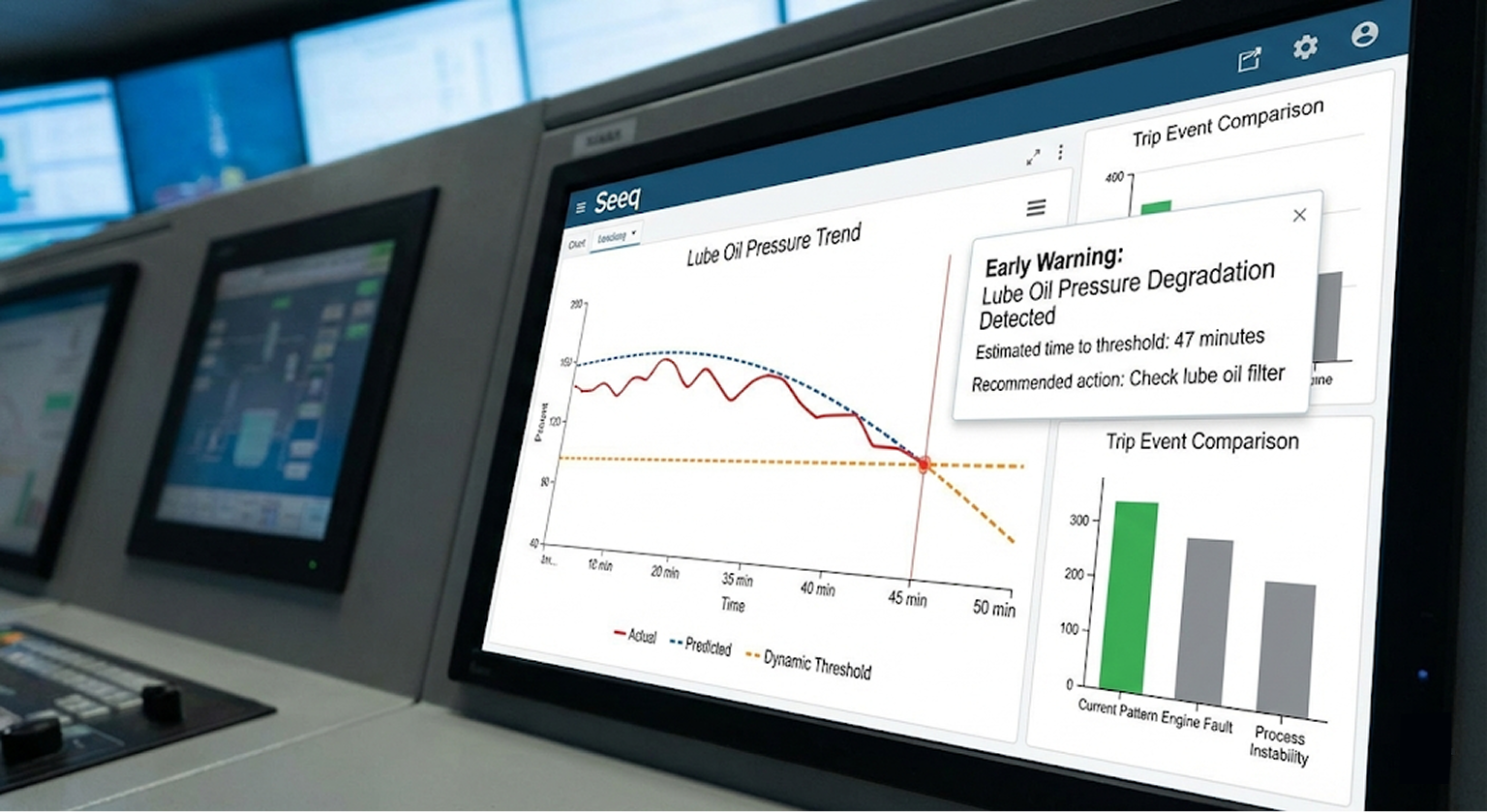
PTTEP implemented a predictive reliability framework by integrating data from multiple offshore process historians into Seeq for centralized, contextualized analytics.
01
Historian Integration
By streaming critical data—including lube oil temperature and pressure, vibration signals, inlet gas conditions, and engine performance parameters—from multiple offshore process historians into a single real-time environment, PTTEP successfully unified its engine, mechanical, and process domains into one cohesive analytical workspace.
02
Self-Service Predictive Analytics
Engineers leveraged this centralized platform to independently build and deploy predictive models, completely removing the bottleneck of relying on external data science teams. This self-service capability allowed domain experts to rapidly iterate on event aggregation, correlation modeling, and dynamic threshold optimization using their direct field expertise.
03
Early Warning Deployment
Rather than diagnosing trips after they occurred, the engineering teams operationalized their predictive indicators into real-time dashboards and automated alerts. This proactive approach provided operators with 30 to 60 minutes of advanced warning before a trip condition, clearly differentiating process-related instability from engine faults and opening actionable windows for pre-emptive intervention.
Benefits
Driving Production Continuity and Asset Reliability
Operational Efficiency
- Reduced unplanned compressor trips
- Shorter recovery times
- Improved production continuity
Asset Reliablility
- High-accuracy trip prediction
- Improved root cause clarity
- Reduced mechanical stress from repeated shutdown cycles
Sustainability
- Reduced flaring associated with unstable compression
- Lower operational disruption and emergency mobilization
Organizational Impact
- Shift from reactive troubleshooting to predictive asset management
- Unified cross-domain data visibility
- Engineers empowered with self-service advanced analytics tools
Cost Saving
Avoiding Production Losses and Emergency Interventions
Avoided production losses and reduced emergency interventions represent significant annual financial impact.
To review the quantified opportunity-loss avoidance model and financial benefit analysis for offshore compression assets, connect with us directly for a detailed cost-saving assessment.