


Company Background – SYS
Predictive Unit Weight & Mass Balance Optimization
Siam Yamato Steel Co., Ltd. (SYS) is a leading structural steel manufacturer specializing in H-beams and large structural sections for infrastructure and construction projects. In rolling operations, unit weight precision is critical — even small deviations directly impact material yield, compliance, and profitability. Unit weight control in heavy section rolling is not just a quality metric — it is a margin lever.

Challenges
The High Cost of Reactive Unit Weight Control
In heavy section rolling, unit weight precision is not just a quality metric—it is a critical margin lever. SYS faced persistent tension between “steel giveaway” (producing overweight beams) and tolerance violations (falling outside acceptable limits). Because analysis was disconnected across more than 150 mill signals, operators lacked a forward-looking capability to adjust roll gaps or temperature settings before the material moved outside specifications. This reliance on manual batch averages and post-production root cause investigations resulted in excess raw material consumption, process variability between shifts, and an increased risk of rework and scrap.
SYS faced persistent tension between:
- Steel Giveaway – Producing overweight beams beyond target
- Tolerance Violations – Falling outside acceptable limits
- Manual review of batch averages
- Limited predictive visibility before rolling completion
- Root cause investigations performed post-production
- Disconnected analysis across 150+ mill signals Operators lacked a forward-looking capability to adjust roll gap or temperature settings before material moved outside specification.
This reactive approach resulted in:
- Excess raw material consumption
- Rework and potential scrap
- Process variability between shifts
- Inconsistent benchmark standardization

Solution
Predictive Process Intelligence for Mass Balance
SYS implemented a predictive Mass Balance Intelligence System by integrating mill data into Seeq for centralized analytics and model deployment.
01
Historian Integration
Production data from multiple plant systems—including roll gap settings, roughing and finishing parameters, temperature zones, and tension speeds—was continuously streamed into a centralized platform. By aggregating more than 150 process signals into structured “Sub-Process Zones,” the team enabled deeply contextualized analytics rather than relying on isolated signal reviews.
02
Self-Service Predictive Analytics
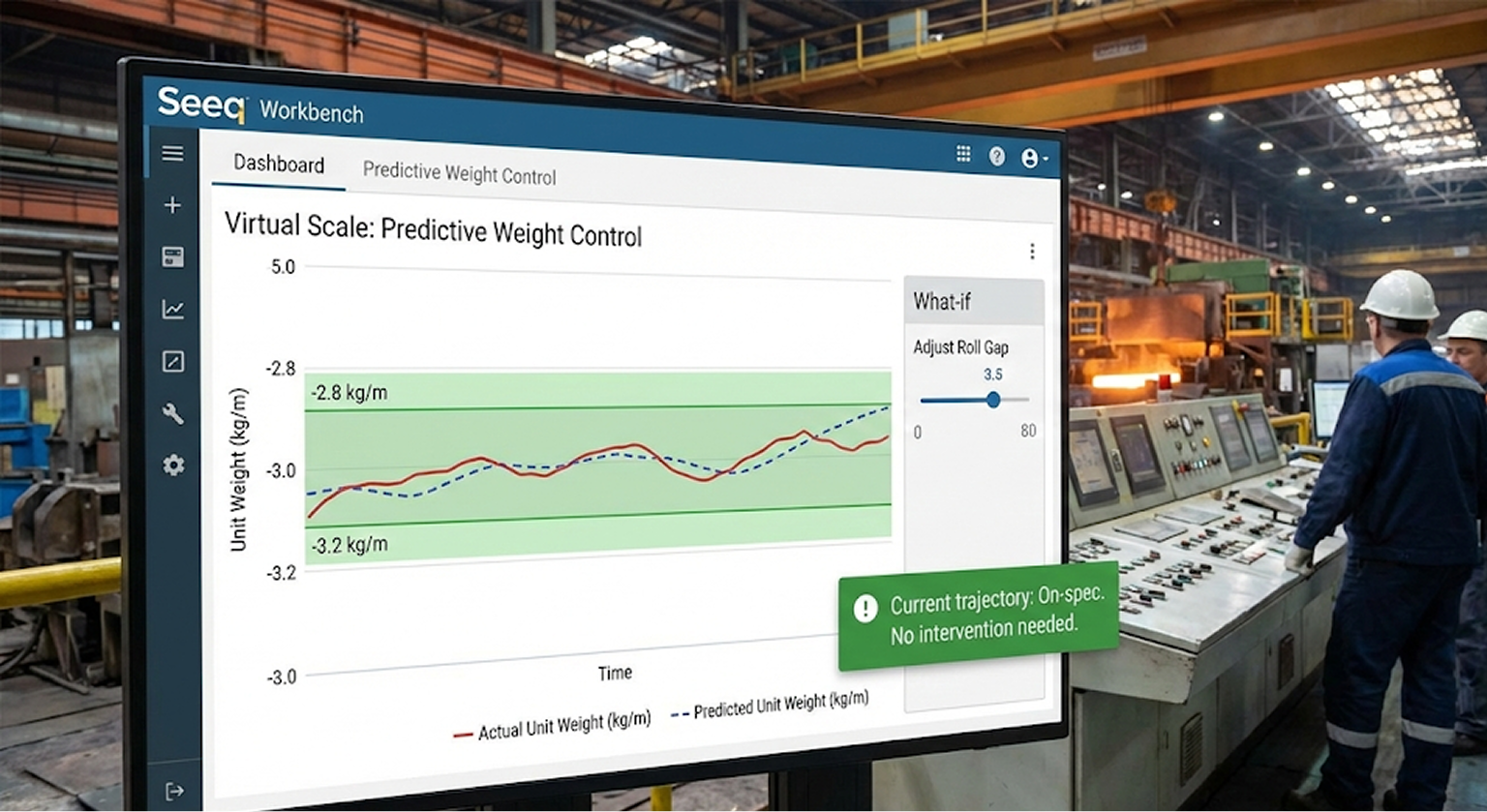
Using embedded Python modeling, engineers deployed a 300-tree Random Forest “Virtual Scale” model that stripped administrative tags to ensure accurate, physics-based forecasting. This provided operators with a real-time predicted unit weight before final measurement, allowing them to monitor trends against tolerance bands and intervene long before the steel was fully rolled.
03
Golden Batch Benchmarking
The system automatically identified a historical “Golden Batch” specifically optimized for weight stability. By continuously comparing current production distributions against this best-run baseline, operations could instantly detect variability, accurately benchmark material yield, and standardize their most optimal operating conditions.
04
Historian Integration
Production data from multiple plant systems—including roll gap settings, roughing and finishing parameters, temperature zones, and tension speeds—was continuously streamed into a centralized platform. By aggregating more than 150 process signals into structured “Sub-Process Zones,” the team enabled deeply contextualized analytics rather than relying on isolated signal reviews.
Benefits
Maximizing Material Yield and Process Stability

Operational Efficiency
- Reduced steel giveaway through tighter unit weight control
- Real-time look-ahead capability for roll gap adjustment
- Lower process variability between shifts

Financial Performance
- Reduced excess material consumption
- Lower scrap and rework risk
- Improved yield stability across production runs

Quality & Compliance
- Predictive avoidance of tolerance violations
- Clear traceability for audit and compliance
- Standardized benchmark operating strategy

Organizational Impact
- Eliminated spreadsheet-based batch analysis
- Engineers empowered with self-service modeling tools
- Transition from reactive inspection to predictive mass balance management
Cost Saving
The Financial Leverage of Material Optimization
Material giveaway in heavy steel rolling represents a tremendously high-leverage cost driver, as even minor overproduction per beam scales significantly across monthly tonnage. The predictive Virtual Scale framework actively enables a measurable reduction in excess steel usage, off-spec production, and process instability losses. For a detailed financial impact model—including yield improvement percentages, material cost savings per ton, and annualized margin uplift—connect with us to review the structured cost-saving assessment specific to rolling operations.