


Company Background – IOCL
Optimize Pipeline Operations with Drag Reducing Agents and Pump Configurations
Indian Oil Corporation Limited (IOCL) is India’s largest downstream oil company, operating extensive multi-product hydrocarbon pipeline networks that transport fuels across long distances and multiple pumping stations.
These pipelines are strategic national assets where energy efficiency, throughput reliability, and operating cost control are critical to meeting growing fuel demand while supporting sustainability commitments.
Challenges
The Complexities of Multi-Batch Pipeline Hydraulics
Managing multi-segment, batch-based pipelines is highly complex due to continuous variations in fluid density, viscosity, and flow rate requirements. Historically, operators were forced to rely on offline manual calculations and data fragmented across multiple station historians. Without integrated hydraulic modeling, schedulers faced difficult trade-offs between pump energy costs and Drag Reducing Agent (DRA) chemical costs. This lack of real-time visibility led to inefficient, rule-of-thumb pump configurations, overuse of expensive DRA, and excessive power consumption—driving up operating expenses and avoidable CO₂ emissions.
IOCL operates multi-segment, batch-based pipelines where each batch varies in:
- Density
- Viscosity
- Flow rate requirements
Operational challenges included:
- Inefficient pump configurations driven by rule-of-thumb decisions
- Overuse or underuse of Drag Reducing Agents (DRA)
- Excessive power consumption from over-pumping
- Risk of insufficient head pressure affecting batch interfaces
- Manual hydraulic calculations performed offline
- Data fragmented across multiple pipeline and station historians Without integrated hydraulic modelling and cost optimization, schedulers faced difficult trade-offs between pump energy costs and DRA chemical costs. These inefficiencies resulted in significant annual operating expense and avoidable CO₂ emissions.
Solution
Integrated Optimization for Cost-Minimized Operations
IOCL implemented an integrated pipeline optimization framework using Seeq by connecting multiple process historians across pipeline segments and pumping stations.
01
Historian Integration
To eliminate fragmented data silos, critical operational metrics—including batch volumes, densities, flow rates, pump speeds, power draw, and DRA injection rates—were seamlessly streamed into a single environment. This integration established a unified, contextual analytics layer that spanned across all downstream pipeline segments and pumping stations.
02
Self-Service Pipeline Analytics
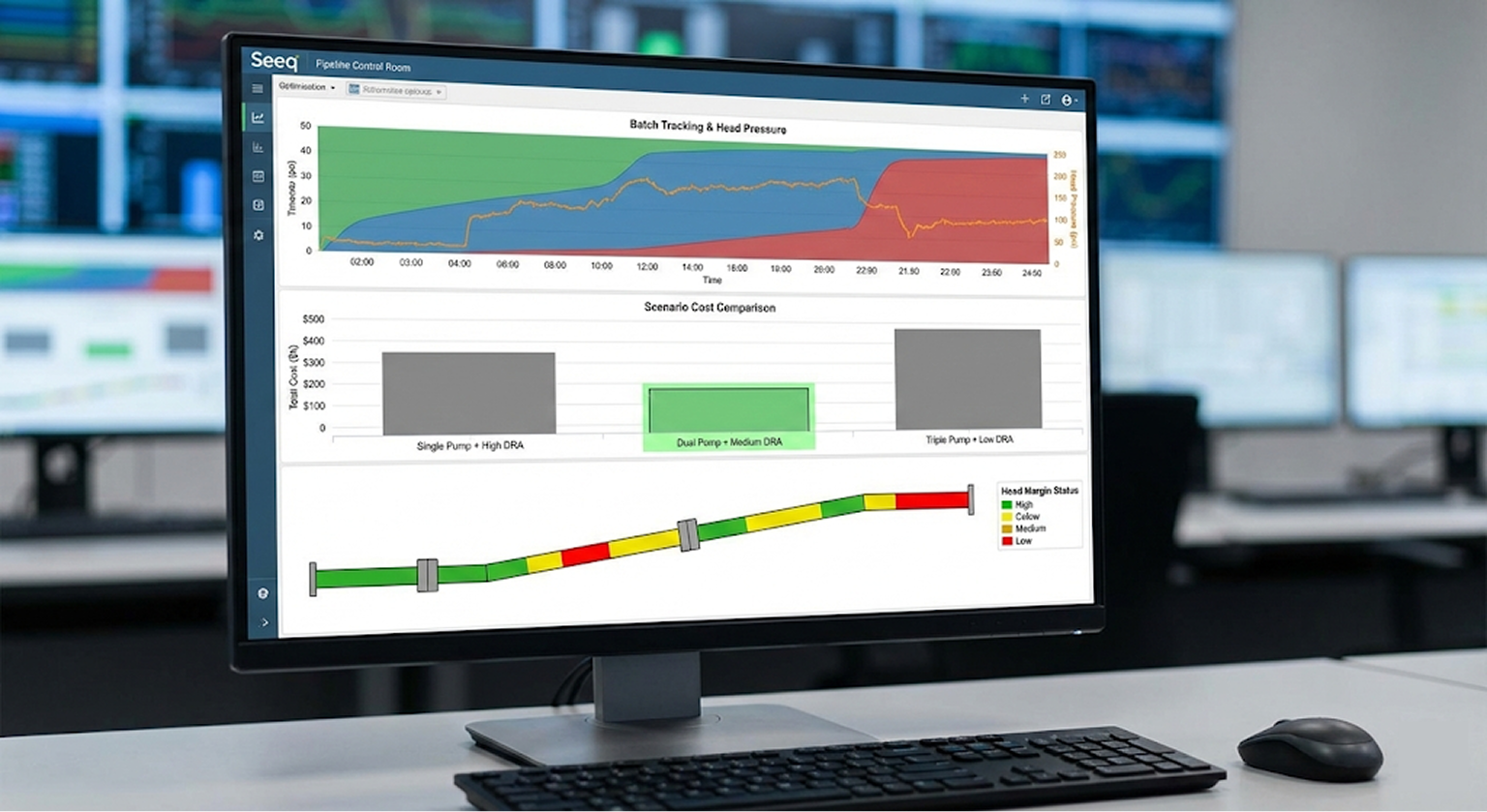
Pipeline SMEs were empowered to independently build and maintain optimization logic without relying on external data science teams. Engineers could rapidly test operating strategies for varying batch conditions directly within the platform by performing hydraulic head calculations, overlaying pump performance curves, and evaluating single, dual, or triple pump configurations.
03
DRA & Energy Cost Optimization
For scenarios lacking sufficient hydraulic head, custom models accurately calculated the required Drag Reduction Fraction (DRF) and translated it into the precise, optimal DRA dosage. By dynamically balancing pump energy consumption against chemical costs and identifying RPM reduction opportunities, the system provided schedulers with visually validated, cost-minimized operating recommendations for every batch.
Benefits
Driving Efficiency, Reliability, and Sustainability

Operational Efficiency
- Optimized pump configurations per batch
- Reduced over-pumping and energy waste
- Faster, data-driven pipeline scheduling decisions

Financial Performance
- Reduced energy and DRA chemical consumption
- Improved utilization of existing pumping infrastructure
- Lower total cost per batch transported
Sustainability
- Reduced electricity consumption across pumping stations
- Lower CO₂ emissions from optimized RPM and pump usage
- Improved alignment with energy efficiency goals

Organizational Impact
- Eliminated spreadsheet-based hydraulic analysis
- Enabled true self-service optimization by pipeline engineers
- Created auditable, repeatable decision workflows
Cost Saving
Millions Saved Through Energy Optimization and Avoided Failure
In the pipeline application, this approach enabled evaluation of 25+ operating scenarios per batch, identifying optimal DRA dosages and pump configurations that delivered double-digit percentage reductions in operating cost while reducing emissions.
To understand the detailed cost-saving model — including energy reduction, DRA optimization, and annualized financial impact — connect with us to review the pipeline-specific cost assessment framework.