


Company Background – SCG
Improving Product Quality Stability Through Data-Driven Analytics
SCG Chemicals Public Company Limited (SCGC) is one of Southeast Asia’s leading integrated petrochemical producers, supplying high-performance chemical products used in packaging, automotive, and industrial applications. Maintaining consistent product quality across large-scale continuous production units is critical to ensuring customer compliance, maximizing yield, and protecting operational profitability.
At SCG TPE, product quality stability—specifically Methanol levels in PY—was a key operational performance indicator directly affecting downstream processing efficiency and product acceptance.

Challenges
The Cost of Quality Variability and Reactive Operations
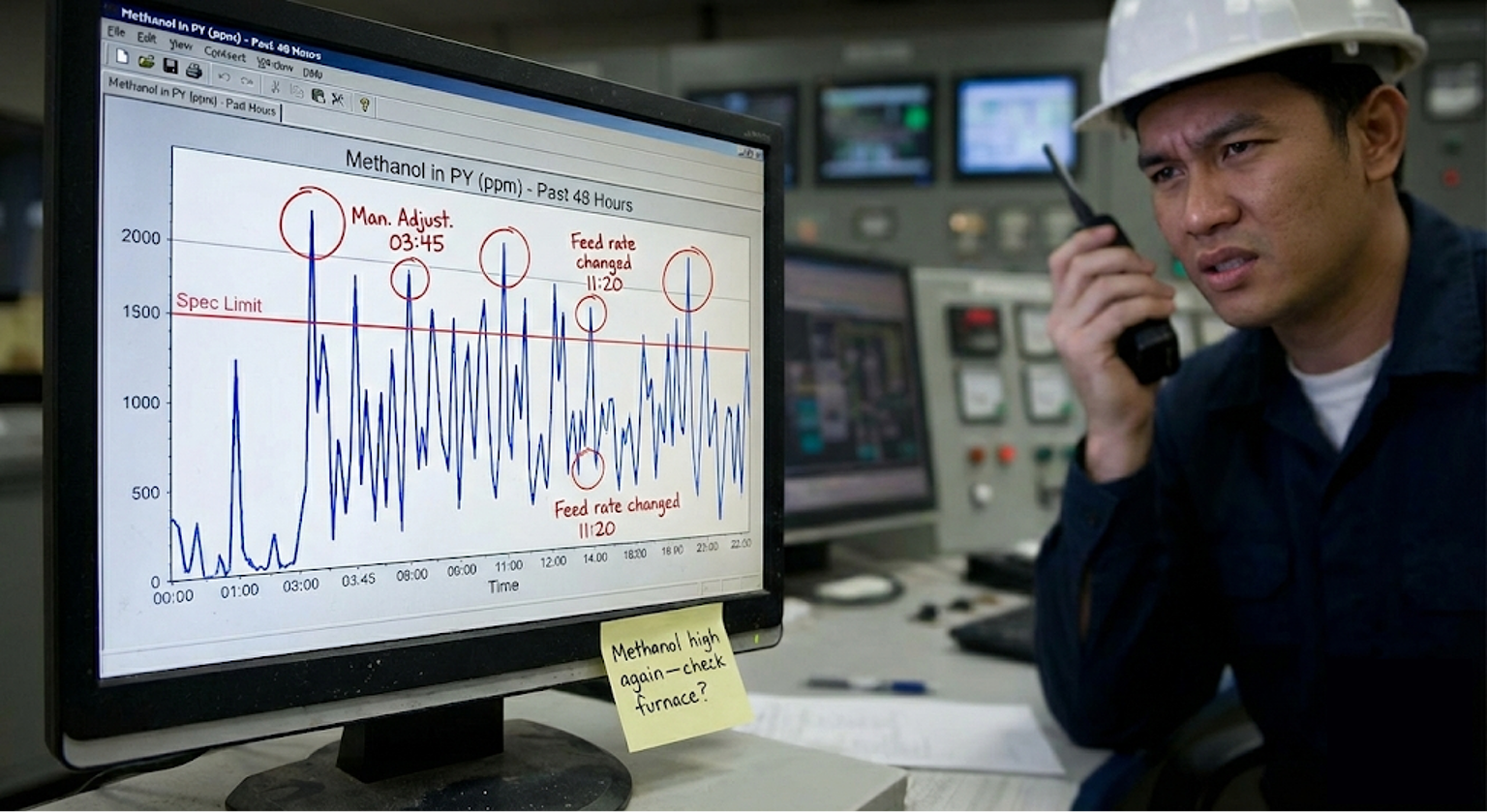
SCG TPE faced persistent product quality variability, specifically regarding elevated and unstable Methanol levels that threatened product specification compliance. Without a unified analytics framework, engineers lacked visibility into the true cause-and-effect relationships between process variables and quality outcomes. This forced operators into a cycle of reactive adjustments and inconsistent decision-making across shifts. The inability to distinguish normal process variability from early indicators of quality degradation ultimately increased the risk of off-spec production, leading to material waste and measurable financial loss.
SCG TPE faced persistent product quality variability driven by complex interactions between multiple process variables.
- Elevated and unstable Methanol levels affecting product specification compliance
- Reactive operator adjustments due to lack of predictive insight
- Limited visibility into true cause-and-effect relationships between process parameters and quality outcomes
- Difficulty distinguishing normal process variability from early indicators of quality degradation
- Inconsistent decision-making across shifts and operators Quality instability led to reactive adjustments, operational uncertainty, and increased risk of off-spec production, resulting in material waste and financial loss. Without a unified analytics framework, engineers relied on manual analysis and experience-based decisions rather than systematic, data-driven optimization.
Solution
A Data-Driven Framework for Quality Stability
SCG TPE implemented a structured analytics framework by connecting plant process historians and operational data streams into Seeq, enabling centralized, contextualized analysis and self-service analytics.
01
Historian Integration
By connecting multiple plant data sources and process historians into a single platform, the team successfully streamed real-time and historical process data. This unified critical metrics—including reactor temperatures, pressures, feed composition, flow rates, and quality measurements—into one contextualized analytics environment.
02
Self-Service Analytics
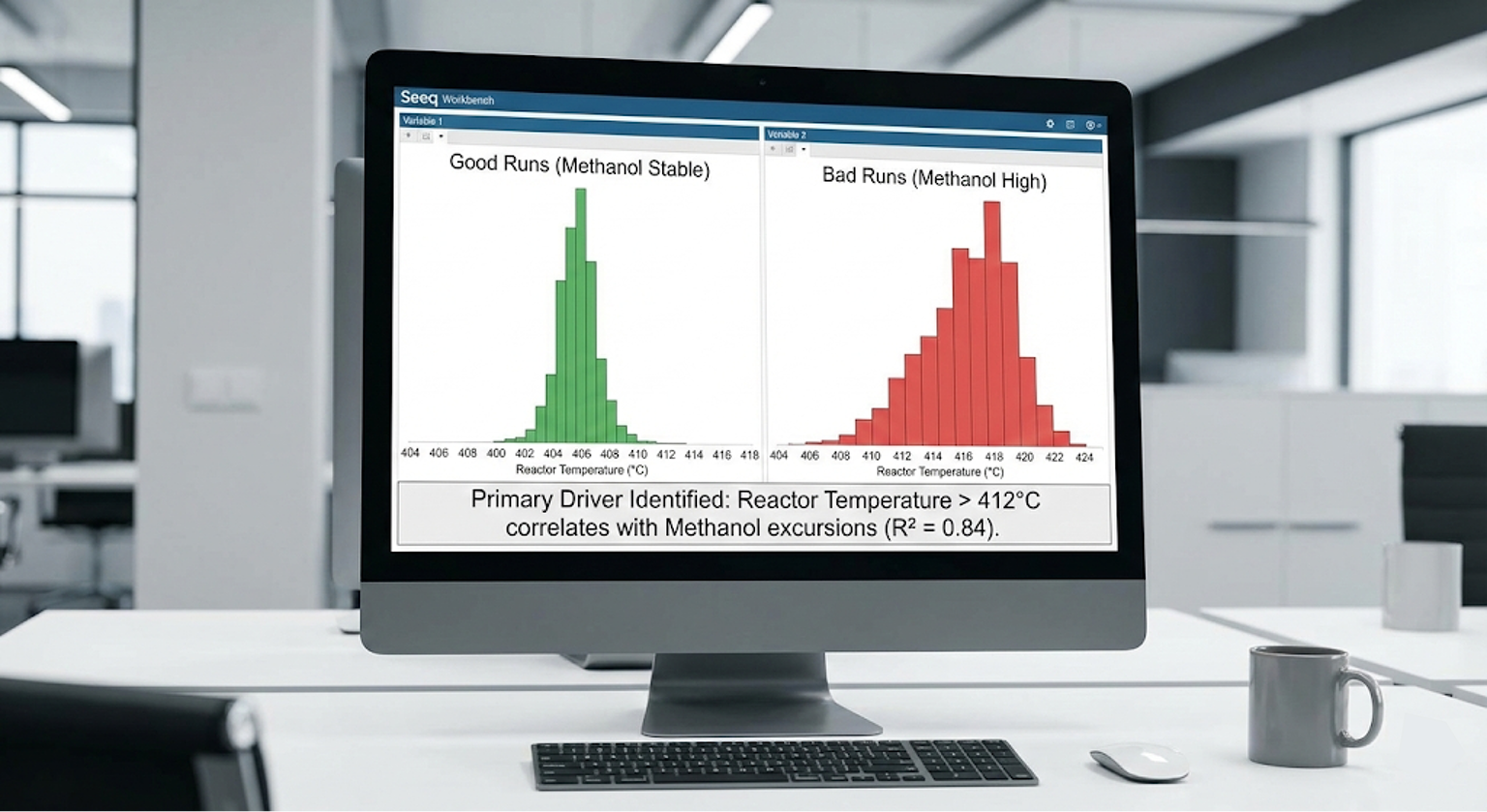
Process engineers were empowered to independently analyze historical data using multivariate statistical analysis to pinpoint the dominant drivers of Methanol variability. By classifying production periods into “good-run” and “bad-run” conditions and mapping process excursions, the teams moved beyond simple trend monitoring to achieve a comprehensive understanding of root causes.
03
Operational Optimization
These advanced analytics were translated into intuitive visual scorecards and monitoring dashboards. This provided operations and engineering teams with standardized, real-time quality performance visibility and clear operating guidance, enabling them to proactively maintain stable production rather than reacting after deviations occurred.
Benefits
Maximizing Yield, Quality, and Operational Consistency

Operational Efficiency
- Reduced reactive process adjustments
- Improved process stability and operational consistency
- Faster identification of process performance issues

Product Quality & Compliance
- mproved product quality stability
- Reduced risk of off-spec production
- Enhanced compliance with product specifications

Yield Optimization
- Improved production yield by reducing quality deviations
- Reduced material waste and reprocessing requirements

Organizational Impact
- Enabled self-service analytics for process engineers
- Improved alignment between operations, engineering, and management
- Established foundation for proactive quality management and continuous improvement
- These improvements enabled SCG TPE to transition from reactive troubleshooting to predictive, data-driven process optimization.
Cost Saving
The Financial Impact of Yield Optimization
Product quality variability directly impacts production yield, material waste, and operational efficiency. By stabilizing Methanol levels and reducing off-spec production, SCG TPE significantly improved process efficiency and reduced production losses.
For a detailed cost-saving assessment—including yield improvement modelling, waste reduction analysis, and annualized financial impact—connect with us to review the structured financial impact framework for product quality optimization.