Tech Curve – Strategic process for your profits The most optimal consulting solution.

Optimizing Gas Turbine Reliability & Efficiency

Let’s Work Together

Call us directly, submit a sample or email us!

Address Business
Ocean tower 2, Unit 23 floor, 75/46 Soi Sukhumvit 19 (Wattana), Sukhumvit Road, North Klongtoey, Wattana, Bangkok 10110
Contact Us
Call : +66994200465 |
+66 2 258 6228
Email : info@techcurve.co | sales@techcurve.co
Working Time
Monday – Friday
8:30hrs – 17:30hrs

Company Background

Chevron Thailand Exploration and Production, Ltd. is a major offshore upstream operator in the Gulf of Thailand, producing natural gas that supports Thailand’s national energy supply. Operations span multiple remote wellhead platforms where rotating equipment reliability is directly tied to production continuity and national energy security.

Gas turbines driving pipeline compressors are among the most critical and energy-intensive assets in this offshore network.

Challenges

Gas turbines were responsible for a significant portion of platform fuel gas consumption. Operations relied on: 
  • Fixed, conservative compressor discharge pressure setpoints
  • Time-based maintenance strategies 
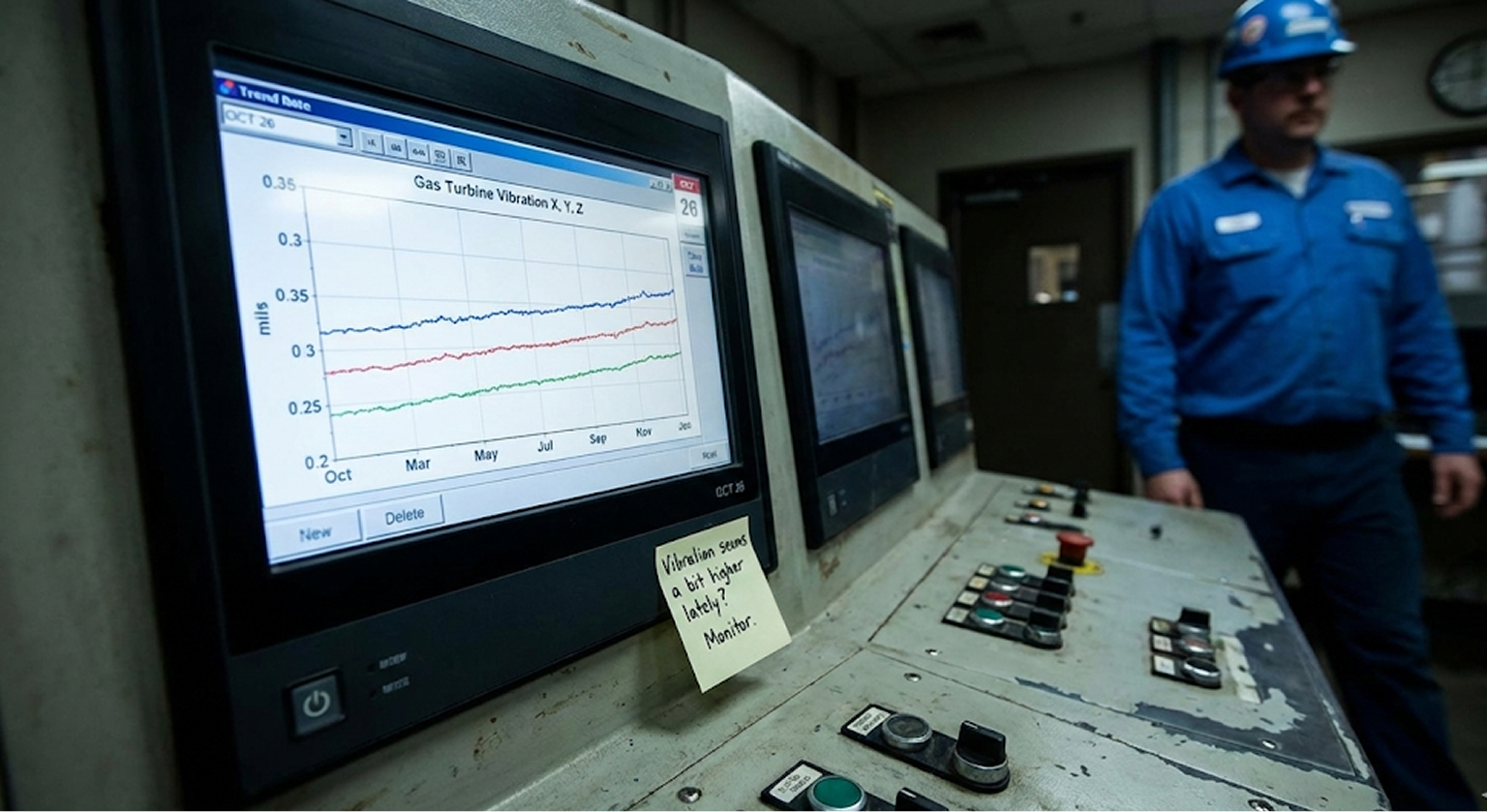
  • Basic vibration monitoring without predictive insight 
  • Limited cross-asset visibility across offshore historians 
This resulted in: 
  • Excess fuel gas consumption 
  • Elevated CO₂ emissions 
  • Risk of catastrophic turbine failure due to undetected degradation 
  • Reactive troubleshooting rather than predictive intervention 
  • Manual data extraction from multiple process historians
In offshore environments, even a single compressor trip can cascade into major production losses.

Solution

Chevron implemented a unified analytics framework using Seeq to connect and contextualize data from multiple process historians deployed across offshore assets.
1.Historian Integration
Operational data from various historians (e.g., turbine parameters, vibration signals, pressure, temperature, fuel flow) was connected and streamed into Seeq in real time. This eliminated siloed analysis and manual data stitching. 
2.Self-Service Analytics
Using Seeq Workbench, engineers and reliability specialists performed their own advanced analysis without dependence on data scientists. Capabilities included: 
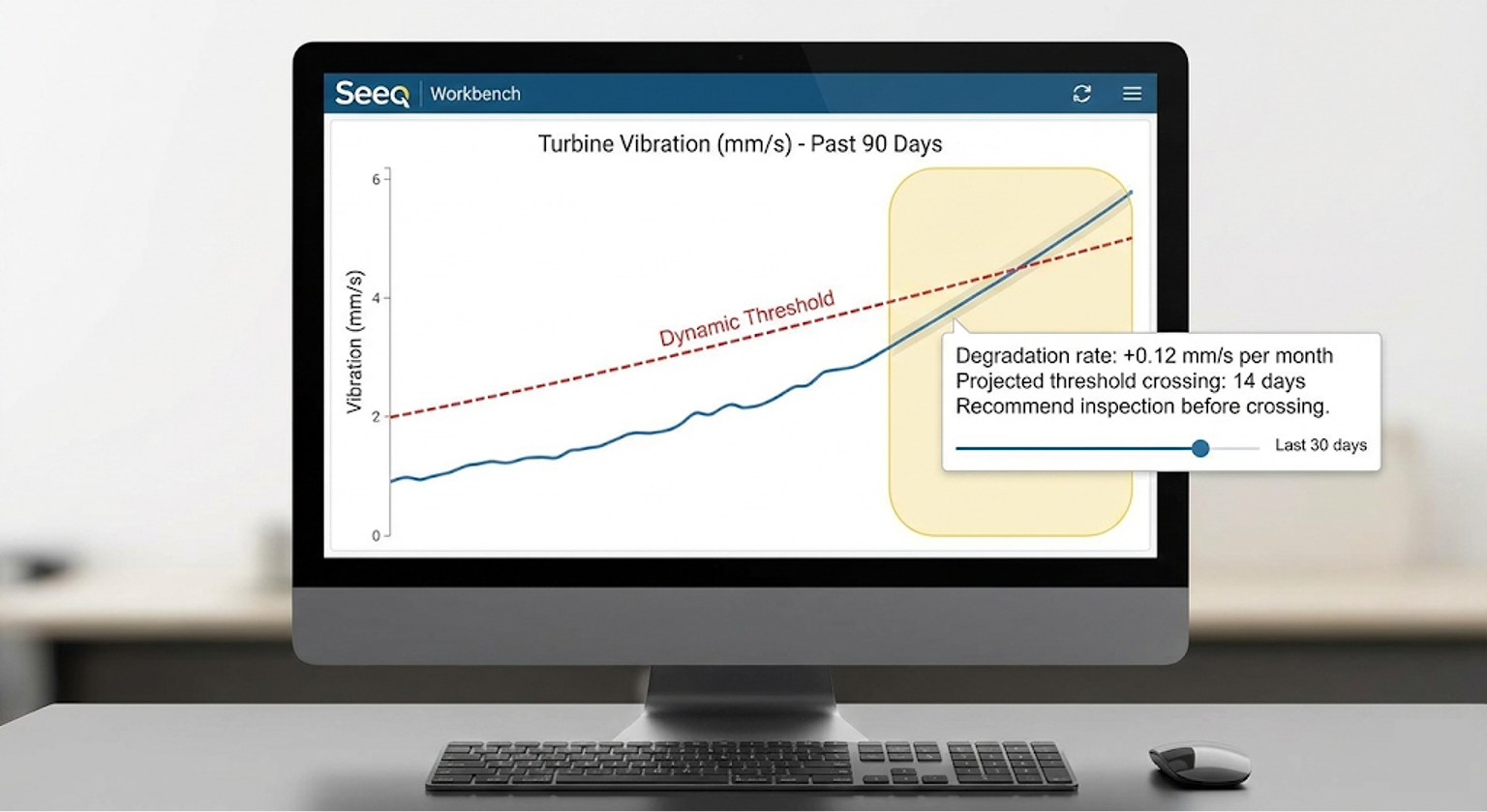
  • Dynamic standard deviation monitoring on vibration signals 
  • Fuel gas consumption modelling 
  • Differential pressure trending 
  • Forecasting degradation trends 
  • Creating threshold-based early warnings 
This shift to self-service analytics enabled rapid iteration, hypothesis testing, and validation by domain experts directly. 
3.Operational Optimization
Separator and compressor scrubber pressure stability was analysed to replace fixed back-pressure control with adaptive dynamic control.  Compressor discharge pressure was safely reduced from conservative levels while maintaining system stability.  Predictive alerts were deployed to provide early detection of abnormal vibration behaviour and mechanical degradation. 

Benefits

Operational Efficiency 
  • Reduced fuel gas consumption by optimizing discharge pressure 
  • Improved turbine load management 
  • Reduced unnecessary maintenance interventions 
Asset Reliability 
  • Early detection of abnormal vibration patterns 
  • Reduced risk of catastrophic turbine failure 
  • Shift from reactive to predictive maintenance 
Sustainability
  • Lower fuel gas usage 
  • Reduced CO₂ emissions from turbine operation
Organizational Impact 
  • Engineers independently built analytics models 
  • Eliminated manual historian exports and spreadsheet analysis 
  • Established a repeatable reliability analytics framework 
x

Contact Us

Ocean tower 2, Unit 23 floor, 75/46 Soi Sukhumvit 19 (Wattana), Sukhumvit Road, North Klongtoey, Wattana, Bangkok 10110

+66994200465 | +66 2 258 6228 

Mon – Fri: 8:30hrs – 17:30hrs